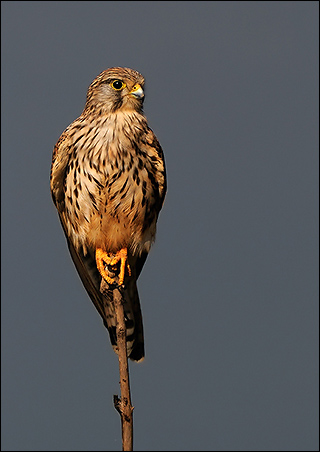
Not sure how many of you have seen a very interesting recent ad by Canon – “Art and Artist”. If I remember it right it showed an image of a dancer performing with “Art” written near it and beside it was an image of a Canon 1D Mk3 with “Artist” written near it !! I had a nice laugh thinking about an extension of such an image shown below. How could Canon forget about the poor porter (also known as photographer ) who carries this artist on a tripod everywhere ? ! I think without their knowledge (hopefully!) Canon ridiculed every photographer with that ad 

On a philosophic note can a camera ever become an artist ? Modern day digital cameras have powerful computing infrastructure within their hood. Considering computers can play and out smart humans in games like chess can’t they out smart we photographers some day and Canon’s vision really coming true ?
Here are some of my formal looking informal thoughts on possibility of camera really becoming an artist.
According to Church-Turing Thesis if there is an algorithm or a program then there is a Turing Machine that can be constructed to run that algorithm. In other words today’s Random Access Stored Program computers are bound by Turing Machine in its computing capability. So as described in the above Wiki link today’s computers can be abstractly described as a 7-tuple –  . What is interesting note here is the the transition function
  is a finite table which essentially is heart of the program or the algorithm. Summary being capability of computers are clearly understood today in terms of capability of the Turing Machine – a mathematical model for today’s computers.
If we can describe computers using this model, is it possible to arrive at such a model to describe a human computing machine – the brain ? Is there such a 7-tuple or n-tuple that can be formulated to describe human brains ?
Today how human brain works is a big mystery. For now let us assume science in a few light years from now will find one such n-tuple representation to express human mind and its computing power. Let us also assume such an n-tuple has a transition function similar to δ shown above. One quick observation that can be made is such a transition function δ will not be static since we humans have a remarkable inherent ability to learn on the fly.
Why humans, I think even small insects’ brain is more powerful than today’s computers in terms of its learning abilities. One day I noticed a mosquito repeatedly hitting a mirror – probably seeing its own reflection in the mirror. It was interesting to know however that after hitting the mirror a few times it quickly learnt the other one is not real and went away. Assuming we had implemented a mosquito using a program and it was programmed to get attracted towards another mosquito we would have seen a bug report seeking implementation of mirror detection logic be included in the firmware of the mosquito because our electronic mosquito did not learn about the mirror at all and went into an infinite loop
The point is there is no way to code all those lessons and experiences of life into programs we write. Having studied computer science I think writing program to create art is beyond my imagination. God has designed a beautiful computing model where transition function δ (if one exists) gets changed on the fly or in other words there is a true learning on the fly. Expression of emotions and feelings are part of this beautiful yet unknown computing model.
How then computers can play chess ? If they can can’t they compose an image ?
Games like chess is a solving a search problem. It is possible to arrive at an algorithm to compare different positions and best move to make. A machine with enough computing power can outsmart human beings even though it indeed takes lots of CPU power to match the mysterious analysis a human mind makes. Problem of composition on the other hand is related to emotions felt in human minds – working of which still remains a mystery. Below is an image I made yesterday. It is an image of the cloud pattern in the sky rotated 90 degrees clockwise. I felt presenting it that way makes it visually stronger abstract image. Here we are dealing with emotions and mystery of learning which is not at all understood by science so far.

Limited imitation of art using computers may be possible but then it is only an imitation not a true creation. I think prerequisite for a camera becoming an artist is we understanding how our own brain works. Hope that happens some day – but my gut feel is it is impossible since there is a complex recursion here – mind trying to understand the mind itself.
Till then following will remain true –

I am sorry Canon